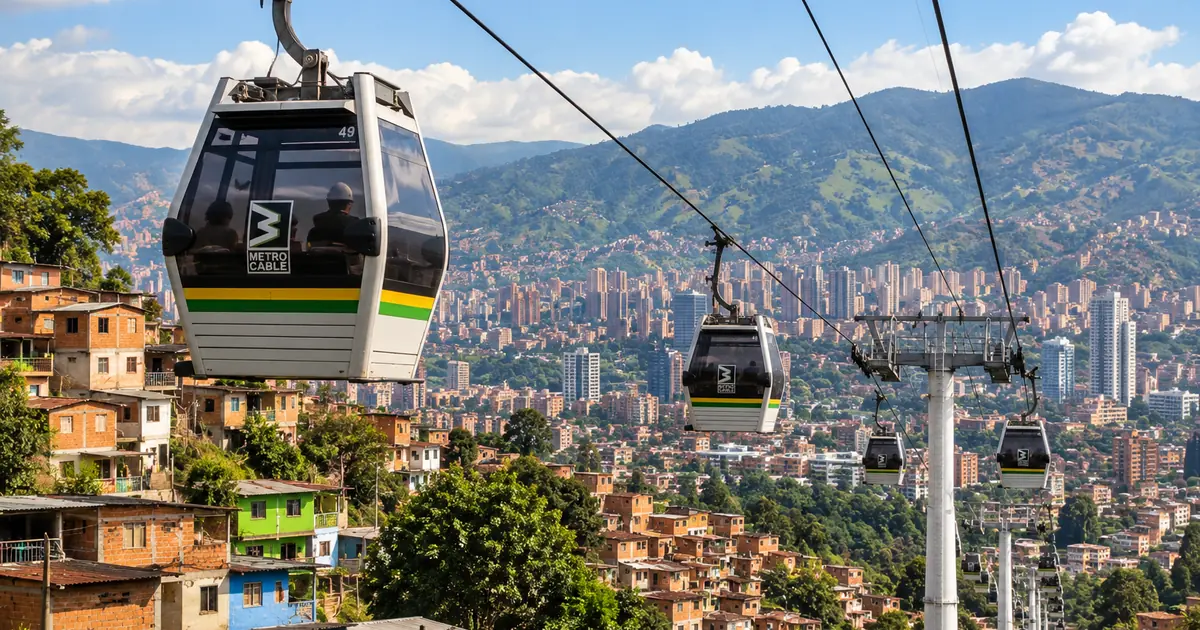
How to use the Metrocable in Medellín and how much it costs
The Medellín Metrocable is the aerial cable system of the metro: cabins that climb from the stations to the neighborhoods on the slopes and that, by the way, offer some of the best views of the city. For the visitor, it is transport and a walk at the same time, and it costs the same as a subway ride.
In this guide we tell you which lines of the Metrocable are available to tourists, how much the Medellín Metrocable costs, what time it operates, how to get to Parque Arví by Metrocable, and what you can see from the line that runs over Comuna 13.
Metrocable Medellín: quick facts
Theme
Date
To take into account
Passage
The same as the metro: about 4,400 COP per trip with the Cívica card
Line L, at Parque Arví, is paid for separately
Card
Bearer certificate, about 12,100 COP
It is purchased and recharged at the metro ticket offices
More useful lines
K, L and J
The K connects with the L to go up to Arví
General schedule
Similar to the metro: from 4:30 a.m. to 11:00 p.m.
Shorter on Sundays and public holidays
Schedule of the L Line
Monday through Saturday, from 9:00 a.m. to 6:00 p.m.; Sundays and holidays, from 8:30 a.m. to 6:00 p.m.
It closes on Tuesdays for maintenance.
Connection
From the metro stations, without leaving the system
Acevedo (Line A) and San Javier (Line B) are the most used
Below we explain each point so that you can use it without any complications.
What is the Metrocable and how does it work
The Metrocable is part of the Medellín Metro system. It was created to connect the downtown area with the neighborhoods built in the mountains, where the metro does not reach. Its first line, the K, began operating in 2004 and connects the Santo Domingo Savio neighborhood with the Acevedo metro station.
It works like an extension of the metro: you get to a connecting station, you follow the corridors without leaving the system, and you get on a car. The cars pass every few seconds, so you almost never have to wait long, except during peak hours.
Please keep in mind that this is the daily transportation for thousands of residents of these neighborhoods. Use it with respect: give up your turn in the rush hour queues and avoid stopping to take photos.
Why the Metrocable is famous
The Metrocable became a symbol of Medellín's transformation. Before its arrival, those living high up on the hills had to spend hours to get to the city center through steep and congested streets. The cable shortened those journeys to minutes and connected those neighborhoods with the rest of the city.
Parks, libraries, and public spaces were built around the stations as part of what in Medellín is known as social urbanism. That is why the Metrocable is being studied as an example in other cities around the world, and for visitors climbing into one of its cabins is also a way of understanding the city’s recent history.
The Medellín cable metro lines that serve tourists the most
The system has several lines, but these are the ones that are most useful for those visiting the city:
Line
Itinerary
How to get there
What do you see?
K
Acevedo – Santo Domingo Savio
Acevedo Station, Line A of the metro
The barrios of the northeast and the Aburrá Valley from above
L
Santo Domingo Savio – Arví
From Line K, in Santo Domingo
Forest and mountain road to Arví Park
J
San Javier – La Aurora
San Javier Station, Line B of the metro
The slopes of the west, including part of Comuna 13
H
Oriente – Villa Sierra
Ayacucho Tramway Station Oriente
The eastern center of the city
The system also has other lines, such as the M and the P, which mainly serve residents of their neighborhoods.
What to see in Line K and in Santo Domingo Savio
Line K is the most well-known and the best for a first experience. From the cabin you can see how the neighborhoods of the northeastern area stretch up the mountain, with brick houses, terraces, and narrow streets, and as you climb up the view opens up of the Aburrá valley and the Medellín river.
When you reach Santo Domingo Savio, the last station, you will find viewpoints with one of the most extensive panoramic views of the city. There is the building of the Biblioteca España, one of the symbols of the transformation of the area.
If you want to walk around the area, do it during the day near the station, or with a local guide who knows the neighborhood. Many visitors only do the round trip to enjoy the view, or they go straight to Line L and Arví Park.
How much does the Medellin Metro Cable cost?
The Metrocable fare is the same as the metro fare: about 4,400 COP per trip with a Cívica card. If you take the metro and make the connection within the system, the cable is already included in that fare.
To pay you need the Cívica card in person, which costs about 12,100 COP and can be purchased and recharged at the ticket offices at the stations. The same card is valid for the metro, the Metrocable, the tram and the integrated buses.
How to buy and recharge the Cívica card
If this is your first trip, the process is simple:
Go to the box office of any metro station and ask the attendant for a Cívica card.
Pay the card's value and tell the cashier how much credit you want to load. For a day of sightseeing, calculate at least four or five trips.
When you enter, hold the card against the wristband reader. Every time you enter the system, one pass is deducted.
When the balance runs out, recharge it at the box office or at the authorized recharge points.
The bearer card does not have your name on it, so you can share it with another person; however, each person must pass the tourniquet separately and a ticket is deducted for each entry.
The exception is Line L, which goes to Parque Arví. It is a tourist line with its own fare, which is paid separately at the Santo Domingo station: the ticket costs 11,900 COP for nationals and 26,700 COP for foreigners.
Step by step on your first trip on Metrocable
If you have never been up there, here is a typical route from the moment you enter the station until you reach the top:
Enter the metro station, pass the Cívica card through the turnstile and get on the train in the direction you need.
Get off at the connecting station, for example Acevedo for Line K or San Javier for Line J.
Follow the signage to the Metrocable. You don't need to pay again, because you're still within the system.
Line up at the platform. The metro staff will arrange the boarding and tell you when to get on.
Get into the cabin as you slowly move through the station. Enter calmly, sit down, and leave space for others.
Upon arriving at the destination station, the cabin moves slowly again: leaving without haste and following the signage to the exit or to the next connection.
To return, you take the same route in the opposite direction. If you’re going to Parque Arví, remember that in Santo Domingo you have to change lines and pay separately for the section of the L Line.
Metrocable schedule
The lines of the Metrocable operate on a schedule similar to that of the metro, which operates from Monday to Saturday from 4:30 a.m. to 11:00 p.m. On Sundays and holidays, the schedule may change depending on the line, but you can refer to the schedule from 9:00 a.m. to 10:00 p.m.
Line L has a shorter schedule: Monday through Saturday it operates from 9:00 a.m. to 6:00 p.m., and on Sundays and holidays, from 8:30 a.m. to 6:00 p.m. It closes on Tuesdays for maintenance. Before boarding Arví, check the Medellín Metro information to ensure it is not closed due to an emergency.
How to get to Parque Arví on the Metrocable
Climbing up Parque Arví is the most popular plan of the Medellín Metrocable, because it combines three routes: the metro, the cable over the neighborhoods, and the cable over the forest. To do this, follow these steps:
Take the A line of the metro to the Acevedo station.
Make the connection, without leaving the system, to Line K of the Metrocable and get on to the last station, Santo Domingo Savio.
In Santo Domingo, you switch to Line L. Here you pay the fare separately.
Line L crosses the forest to the Arví station, in a journey of about 15 minutes.
In the Arví Park There are trails, green areas and local products stands near the station; some activities have an extra cost. It gets colder up there than in the city, so bring a jacket.
On weekends and holidays, the line for Line L can be long. If you can, try to get on it during the week or early in the morning.
What to do in the Arví Park
Arví Park is a large natural reserve in the mountains of Santa Elena, east of Medellín. Near the station you’ll find the most visited area, with stalls selling local products, food, and handicrafts, and the starting point for several hiking trails.
The most common plans are to walk along the trails among pine forests and native vegetation, have a picnic in the green areas, observe birds, and buy products from the local farmers.
Some tours require prior reservation and have a cost: between 20,000 and 30,000 COP, depending on whether you are a national or a foreigner. They include professional guide, wildlife interpretation, accident insurance, and pre-hospital care service (APH). These guided tours depart from Wednesday to Monday, every hour, between 10:00 a.m. and 3:30 p.m.
How much time to devote to it
Calculate at least half a day for the full plan: between 45 minutes and an hour of travel time from the center to Arví, about two or three hours in the park and the return. If you want to do long trails, dedicate the whole day and leave early, because the L Line has limited hours.
What do you see from Line J of the Comuna 13 cable car?
The J Line leaves the San Javier station on Line B of the metro and climbs up the slopes of the west to La Aurora. Along the way it passes over part of Comuna 13 and offers a wide view of its neighborhoods and the city.
Attention: the graffiti area and the escalators do not go directly on Line J. To get to the graffiti tour, get off at the San Javier station and take a bus or taxi to the 20 de Julio neighborhood. If you want to learn about its history before going, read our guide here. The history of Comuna 13.
If you prefer to do the entire tour with a local guide, our Comuna 13 tour with Metrocable Includes the cable car ride and the graffiti tour. It takes 5 hours, runs from Monday to Saturday, and costs 105,000 COP per person.
Half-day plan with the Metrocable
If you have a free morning, this plan combines the views of Line K with a visit to Parque Arví:
Time
Plan
9:00 a. m.
Metro from the center or El Poblado to the Acevedo station
9:30 a.m.
K Line of the Metrocable to Santo Domingo Savio
9:45 a.m.
Stop at the Santo Domingo viewpoint and change to Line L
10:15 a.m.
Arví Park arrival: local market and short walk along a path
12:30 p. m.
Lunch in the area of the Arví station
1:30 p. m.
Return by Line L, Line K and metro
2:30 p. m.
Approximate arrival to the city center
The times are approximate and may be extended due to the queues at Line L on weekends. If you are traveling during the week, please remember that Line L closes on Tuesdays.
Cable car with children, seniors or reduced mobility
The Metrocable is a plan suitable for the whole family. Children usually enjoy it a lot, and the enclosed cabins make the journey safe and comfortable. Travel with children sitting and avoid them climbing on or playing with the doors.
For older adults or people with reduced mobility, the approach can be the most delicate moment, because the cabin moves slowly as you enter. Ask for help from the station staff, who are there to guide users.
If someone feels dizzy, it is advisable to start with a short route, such as Line K, before venturing onto Line L, which goes higher up over the forest.
Common mistakes when using the Metrocable
Using the Metrocable is easy, but some mistakes can waste your time:
Go to Parque Arví on the day of closure. The L Line closes on Tuesdays for maintenance. Check the schedule before leaving to avoid ending up in Santo Domingo and finding it closed.
We left late for Arví. The L Line operates only during the day. If you take it in the afternoon, you won't have much time to go up and you'll have to queue to go down with all the afternoon visitors.
Confusing the J Line with the graffiti tour. Line J gives a good view of Comuna 13, but the graffiti and escalators are visited on foot from another point in the neighborhood.
Not having enough balance. Recharging at each station takes time, especially during peak hours. It charges the balance from the beginning of the entire journey.
Forget the jacket. In Santo Domingo and, especially in Arví, it is colder than in the valley, and the weather can change quickly.
Block approaching by photos. Take your photos from the cabin or from the observation platforms, not from the platform, where the flow of passengers is constant.
Tips for using the Metrocable
Avoid the morning and afternoon peak hours, when residents go to and return from work, and the queues in Acevedo are longer.
Recharge the Civic Card before starting the tour, so you don't have to queue at each station.
Travel with little luggage: the cabins are small and shared.
Take care of your belongings in busy stations, as in any mass transportation system.
Check the weather: With rain or fog, visibility is reduced, especially on Line L.
Using the Metrocable requires nothing more than a Cívica card with credit and some patience in the queues. In return, it gives you another way to understand Medellín: from above, over the neighborhoods that made it famous for its transformation. And if you prefer to explore it with someone who tells you its history, Turibus will accompany you.
Frequently asked questions
How much does the Metrocable cost?
Same as the metro: about 4,400 COP per trip with the Cívica card, and if you come by metro the connection is already included. Line L, to Parque Arví, has a separate fare.
Which line leads to Parque Arví?
From the Acevedo station, take Line K to Santo Domingo Savio and from there connect with Line L, which goes up to Parque Arví.
What is the schedule for the Metrocable?
It operates on a similar schedule to the metro; it is shorter on Sundays and public holidays. Line L only opens during the day and closes on Tuesdays for maintenance.
Does the Metrocable serve to visit Comuna 13?
Line J runs over part of Comuna 13 and provides a good view, but the graffiti area is walked around on foot. Graffiti tour 13 The Turibus includes the Metrocable and the guided tour with a local guide.
When is it advisable to go to avoid queues?
Outside of the morning and afternoon peak hours, and early on weekends, when more visitors come to Parque Arví.
Is it safe to use the Metrocable?
Yes. It is a public transportation system with staff at the stations and closed booths. As in any crowded place, take care of your belongings and, if you walk through the neighborhoods near the stations, do so during the day.
How long does it take to get to Parque Arví from the city center?
Between 45 minutes and an hour in total: the metro to Acevedo, Line K to Santo Domingo and Line L to Arví, not counting the queues on weekends.
The Medellín Metrocable is the aerial cable system of the metro: cabins that climb from the stations to the neighborhoods on the slopes and that, by the way, offer some of the best views of the city. For the visitor it is transport and a walk at the same time, and it costs nothing.